
Farming has never been a risk-free endeavor, but the ravaging effects of climate change are making the work even more unpredictable. In fact, today some two billion people do not have sufficient or safe access to nutritious food, according to the latest estimates. Innovative technology melding the modern with the traditional can greatly improve practices and yields.
UBC’s Dr. Hannah Wittman and Latin American partners are developing free, open-source, multilingual decision support tools to help farmers around the world assess and improve soil health, climate resilience and food security. And just last month, the Inter-American Institute for Cooperation on Agriculture of the Organization of American States named the project an “AgTech winner” at the international gathering in Costa Rica.
The tools, and accompanying curricula, are part of LiteFarm. That is a digital farm management solution developed by Dr. Wittman’s team of students and community partners at the Centre for Sustainable Food Systems at UBC Farm—now in use by more than 8,500 farmers in 160 countries.
Through digital recordkeeping and data visualization, growers can build their own evidence in choosing the best agroecological practices, document climate resilience outcomes and tell their stories backed up by current data. The ultimate result? Ensuring global food security, mitigating climate change impacts and preserving biodiversity.
In March 2025, Dr. Wittman joined the roster of six UBC researchers* awarded up to $10,000 each from the Seed Funding for Cooperation with the Global South, a competition managed by the UBC Office of Global Engagement and funded by the UBC Academic Excellence Fund. The grant enables researchers to form new collaborations, or strengthen existing ones, with partners in the “Global South” addressing global challengesand promoting sustainable development.
Dr. Wittman’s research focuses on small-scale, resource-limited farmers and documents their positive impacts on global food security and biodiversity conservation. We spoke with her about the new digital agricultural resources and her ongoing collaboration with global partners.
Why did you want to lead this project? Why Latin America in particular?
We’ve been working with a network of Latin American agroecological farmer organizations since 2015. In 2023, two new organizations joined: VIVAMOS MEJOR from Guatemala in Central America and Corambiente in South America. These two brought new expertise, as well as interest in soil health and climate resilience, to our collaboration. We applied for seed funding to bring the partners to UBC to develop new tools for soil health, as part of a broader longer-term project, which includes upcoming workshops this fall.
How did you develop the toolkit?
We are leveraging expertise and collaboration with researchers from UBC Farm, including Dr. Sean Smukler and Dr. Jessica Chiartas, and conducted in-person workshops at UBC Vancouver in June with the Latin American partners. We identified how each partner assesses biological, physical and chemical elements of soil health, and shared our tools and methods, as well as those from the University of California, Davis in the U.S. Then we collected feedback on how to improve and implement.
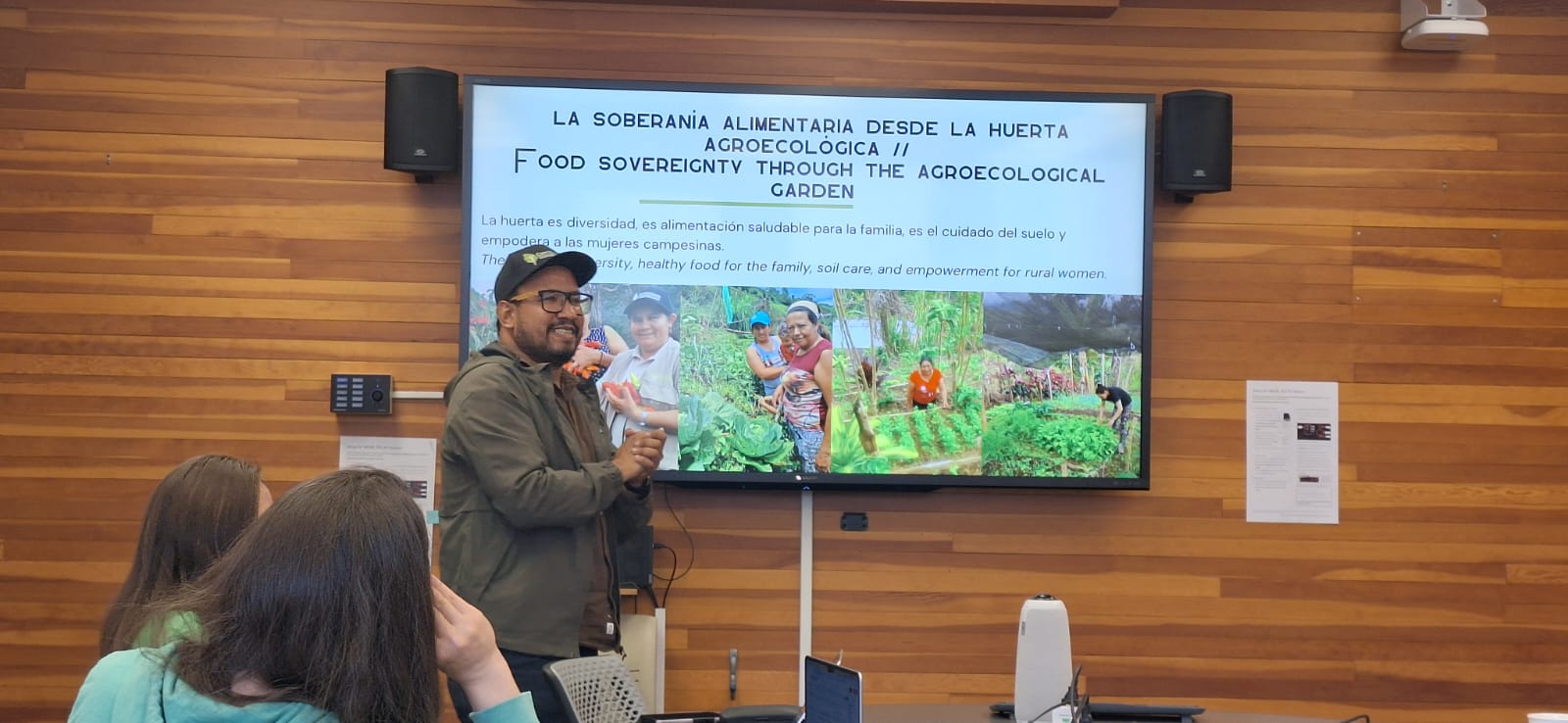
Ricardo Eslava, Corambiente Project Coordinator, presenting the work of NGO Corambiente, from Colombia, at LFS (photo: Clara Comandolli)
How do these tech tools help farmers better assess soil health?
Now, farming support organizations can develop their own educational materials. They can develop technical toolkits for participatory assessment of soil health that are appropriate for their local ecological and agricultural contexts and create soil health action plans. Up to now, farmers in many regions have assessed soil health by proxy looking at crop performance. Occasionally, government extension providers promote laboratory analyses, but these are expensive and generally analyze chemical deficiencies in order to promote the use of synthetic fertilizers. By using qualitative measures, such as the TAPE tool for soil health assessment, and linking soil health and yield outcomes registered in LiteFarm, farmers have a better baseline and benchmarking capacity to link specific practices to outcomes.
“We are using new data analytics to draw broader conclusions.”
What are the main take-aways?
Our June UBC workshop developed a series of questions for future research and knowledge mobilization. We are planning a new participatory action research project linking agroecological practices to soil health and climate resilience. We are also working on a curriculum for farmer field schools so farmers can self-assess and monitor the outcomes of their farming practices using a combination of new digital tools, such as LiteFarm. Some of this is ongoing through work by the community partners, and we are seeking new grants to include new research support.

SPG Committee Delegation at the H.R MacMillan Building; Faculty of Land and Food Systems (photo: Clara Comandolli)
How might the learnings apply to other parts of the world?
The methodologies drawn from this project—including farmer-first data visualization via the Litefarm tool from more than 160 countries—is supporting my group’s long-term research on agroecosystem and food systems transformation. We are using new data analytics to draw broader conclusions on the links between farm size, crop and land use diversification, food and nutritional security, and the gender distribution of labour.
Can you define “sustainable agriculture”?
We use the concept of Agroecology to define “sustainable agriculture.” This is a form of food production that uses ecological principles of diversification, reduction of external inputs, and attention to equity and social justice at all levels—from the household division of labour and poverty reduction, to improved food security and nutrition, to the development of strong local markets for resilient regional food systems.

SPG Committee Delegation branstorming session at the UBC Farm (photo: Carolina Diaz)
Who were the partners on this project?
Dr. Erika Sagae, Project Coordinator, Centre for Research and Promotion of Group Agriculture (CEPAGRO), Brazil; Samuel Secaria, Director, Asociación VIVAMOS MEJOR, Guatemala; Ricardo Eslava, Project Coordinator, Corambiente (Corporación Buen Ambiente), Colombia; CEPAGRO is a member of a Latin American network of organizations promoting sustainable agriculture and participatory education for sustainable development. The network is collaborating with UBC in support of grassroots citizen science network for assessing and communicating agroecological transitions.
What’s next for you?
To continue to engage in participatory action research, led by farmers, to identify pathways for a food-sovereign, climate resilient future!
Read about the UBC Faculty of Land and Food Systems.
Find other UBC faculty-led projects supported by Seed Funding for Cooperation with the Global South.
*Other 2025 Global South seed funding recipients are:
Dr. Rubee Dev, Assistant Professor in the UBC School of Nursing (Faculty of Applied Science): Women’s Hearth Health in Nepal: Missed Opportunities and Paths Forward
Dr. Khumbo Kalua, Associate Professor, UBC School of Population and Public Health (Faculty of Medicine): Global Health Collaboration between UBC and AMIU
Dr. Elizabeth Shaffer, Assistant Professor, UBC School of Information (Faculty of Arts): Strengthening the Refugee Law Project’s Digital Archive
Dr. Fatawu Abdulai, Assistant Professor, UBC School of Nursing (Faculty of Applied Science): Developing Health Informatics Competency Frameworks for Nurses in Ghana
Dr. Sara Beck, Assistant Professor, UBC Department of Civil Engineering (Faculty of Applied Science): Advancing Research on Sustainable Water, Sanitation and Hygiene Solutions

Clara Comandolli, NGO CEPAGRO Communications Lead, presenting the work of Cepagro at LFS (photo: Prabhjot Singh)